Personalization on a Timeline: How Did E-commerce Come to AI-Based Operation?
of marketers agree that personalization is profitable forbusiness.
Google discovered a thoroughly interesting insight here, especially since of customers appreciate personalization as long as it comes from the data they share with a business explicitly.
One might think personalizing the shopping or overall brand experience of consumers is a recent thing. In truth, it has been around for along time. In fact, according to , the first instance of marketing personalization was established in emails, as far as digital channels are concerned.
Personalization has been around since the time of black and white screens, just not on digital platforms. Sales professionals back then were trained to understand the tastes of visiting customers and show them the merchandise accordingly.
With time and the rise of technology, there have been significant evolutionary changes in the way product recommendations are personalized for each consumer. Let’s take a glimpse into the chronicles of eCommerce personalization through the times.
Personalization in the Past
You may not think it possible to apply a sociological concept tomarketing, but Emile Durkheim’s “Cult of the Individual” theory makes surprising sense in the context of marketing and eCommerce personalization today.
Highlighting the sovereignty of the individual in a societal,community-based fabric, this concept celebrates the individual and his supremacy with respect to society.
In the 1980s, coined the term “Relationship marketing,” emphasizing the concept of fostering relationships with customers instead of merely counting sales. The ball was already rolling in the ‘80s.
In 1991 came the true era of the first internet when emails werebeing blast-sent and the word “spam” had become a thing. Emails can be called pioneers of personalized marketing. However, these campaigns were overly simplistic and limited the personalization to simply adding the recipient’s name to the mail.
Following closely were the legacy CRMs on legacy computers in an attempt to process consumer data for the purpose of personalization (a featstill challenging to achieve after three decades).
Businesses soon realized this wasn’t going to get their boats across.
In fact, one of the major realization waves of the significanceof consumer-based personalization was noticed in one of the campaigns of in 2006.
The Person of the Year for that issue was “You.” It was their way of celebrating the impact that user-generated content could create onmarketing, customer satisfaction, personalization, and so much more.
The cornerstone for personalization had been established. To sell more, businesses knew they had to sell differently. And to sell differently, they had to know how and whom to sell to.
Personalization in the Present
Today, with all the buzzwords floating in the marketing universe and with marketers vouching for personalization to boost their revenues,personalization is still in its nascent stages.
A study by highlights just that: only 5% of businesses have actually managed to personalize their offerings and communications with customers. This is still the first level of personalization that the world is witnessing.
eCommerce is at its all-time high and demonstrates one of the finest examples of marketing personalization so far. If you have ever shopped on Amazon, you know it has given you highly relevant product recommendations that have ended up on your checkout list.
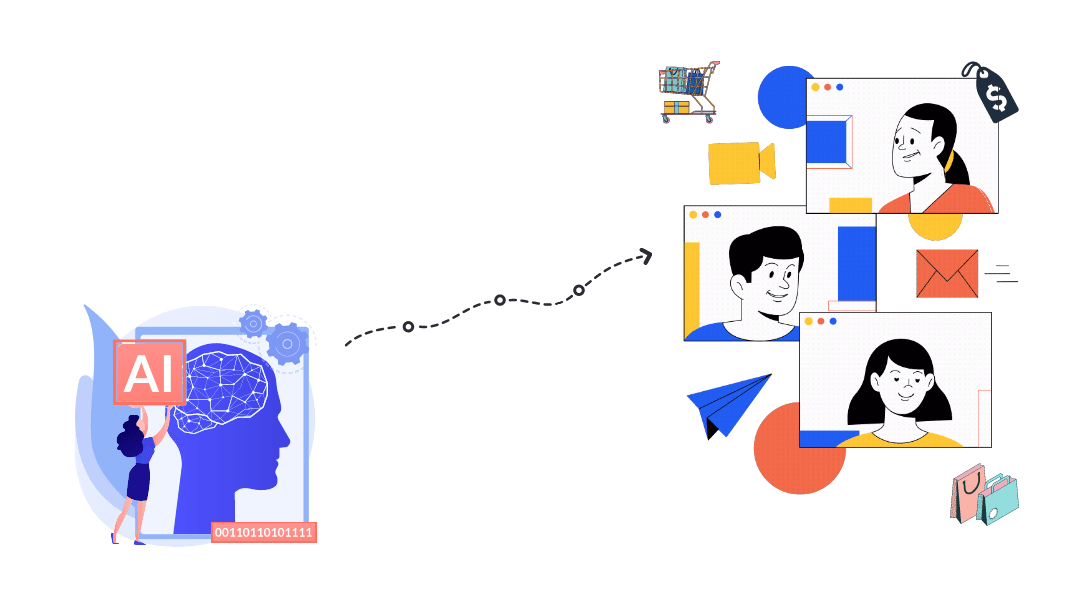
In the context of Black Friday and Cyber Monday, the role ofartificial intelligence in personalizing the eCommerce shopping experience is a major one. Today, AI-powered CRMs (as opposed to the rudimentary setups that marketers struggled with in the ‘90s) assist sales executives with:
• Gathering and processing copious amounts of consumer data
• Zeroing in on consumer insights that brands can capitalize on for generating foo lproof product recommendations
• AI-powered marketing, remarketing, and personalized consumer feedback assist immensely during BFCM sale times to reduce cart abandonment rates. It is undeniable that artificial intelligence has become pivotal for personalizing eCommerce and marketing today.
Personalization in the Future
Personalization is still evolving. It is true that this marketing tactic banks on consumer data, and with the recent data privacy and protection regulations (like the GDPR) coming into effect, some set backs can be expected.
That said, with increased digitalization and data production,cybersecurity issues may lead to more stringent regulations concerning user data. Consumer hesitance to share their data with brands is enhanced because of these security issues. Business dynamics, thus, are likely to keep changing with each new technological innovation.
Artificial intelligence, though, is expected to stay relevant for some time still, as long as eCommerce is booming. The full potential of this technology still remains to be unleashed and realized in eCommerce.
AI, eCommerce, and Personalization GoHand-in-Hand
It is evident that brands need data to personalize eCommerce recommendations during BFCM. For gathering and processing consumer data, brands need computing power and intelligence. This creates an unending loop between AI, eCommerce, and personalization that helps businesses boost their sales during these yearly shopping festivals. This is where Glood.AI comes into play!
Download Our Free E-Book And Get Started Today!
Subtext supporting the title. Lorem ipsum dolor sit amet consectetur. Turpis ullamcorper volutpat augue.
